

US Marshal Hold
US Marshal Hold Inmate Search
A loved one is arrested, and you find them in the county jail. You check the county jail website or call the Sheriff and find out that there is a US Marshal Hold. There may or may not be a bond set on the case. You call a local bonding company, and they tell you that even if you post the bond, they aren’t getting out of jail.
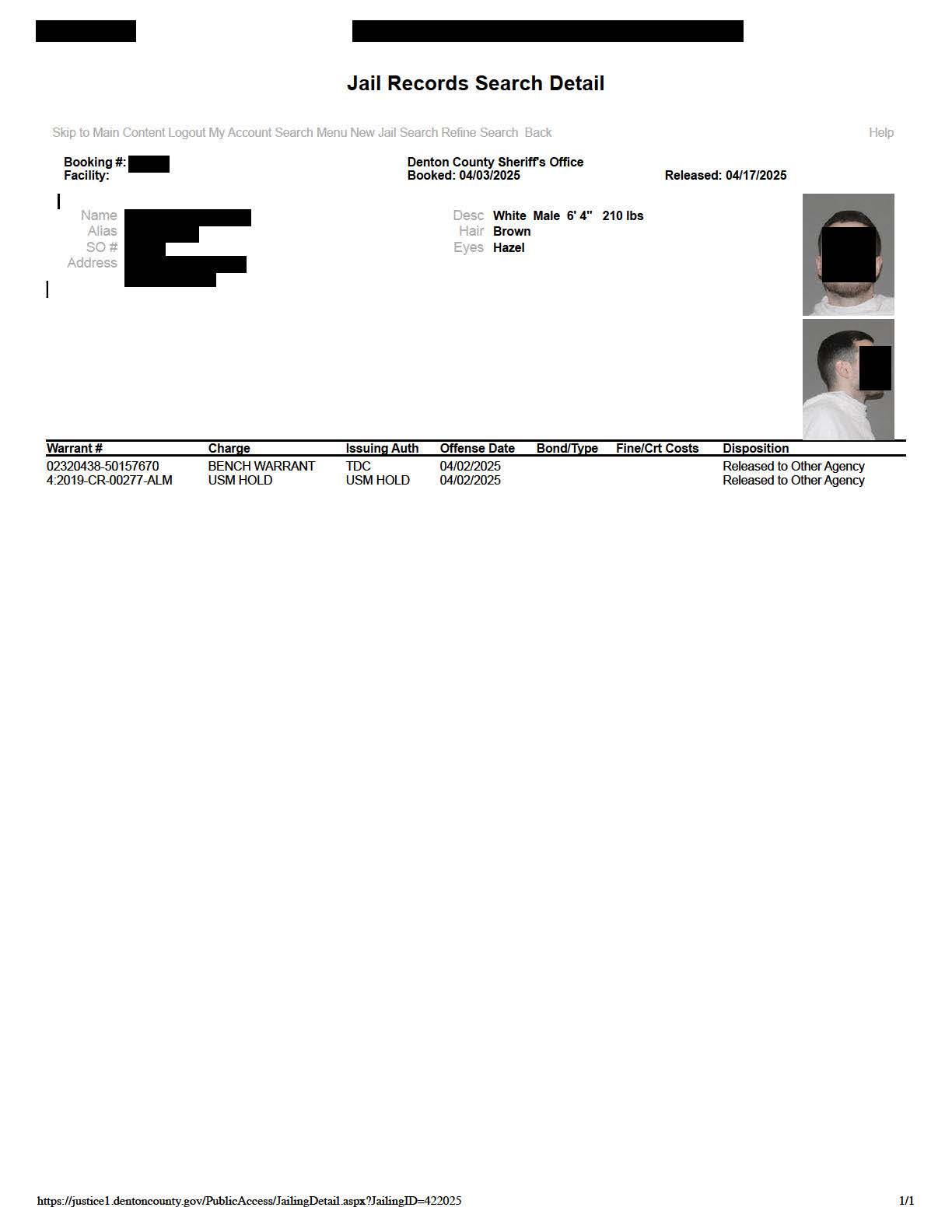
Below is an example from a client’s USM hold in the Eastern District of Texas, Sherman Division, where the client was being held in the Denton County jail.
What is a US Marshal Hold?
A US Marshal hold is a federal detainer on an inmate who is not currently in federal custody. The detainer is the method used to hold someone on a federal warrant who is not currently in federal custody. The hold will generally not be released unless the inmate is brought into federal custody.
In most cases, the person being held in the county jail also has a pending state criminal charge. In all cases, I will make sure that my client does NOT get sentenced or go to trial on the state charges BEFORE the federal case is resolved. (See Below)
Steps a Federal Criminal Defense Lawyer Can Take to Get a US Marshal Hold Released or Lifted
- I will find out which district issued the federal warrant.
- I will contact the duty magistrate in that US Federal District and inquire whether there is already an initial appearance scheduled on the federal case. But usually there is no initial appearance scheduled.
- I will get the federal case number from the US Marshal or the duty Magistrate.
- I will contact the US Attorney assigned to the case and request that they initiate the process with the US Marshals to bring the inmate into federal custody and schedule an initial appearance in front of the US Magistrate.
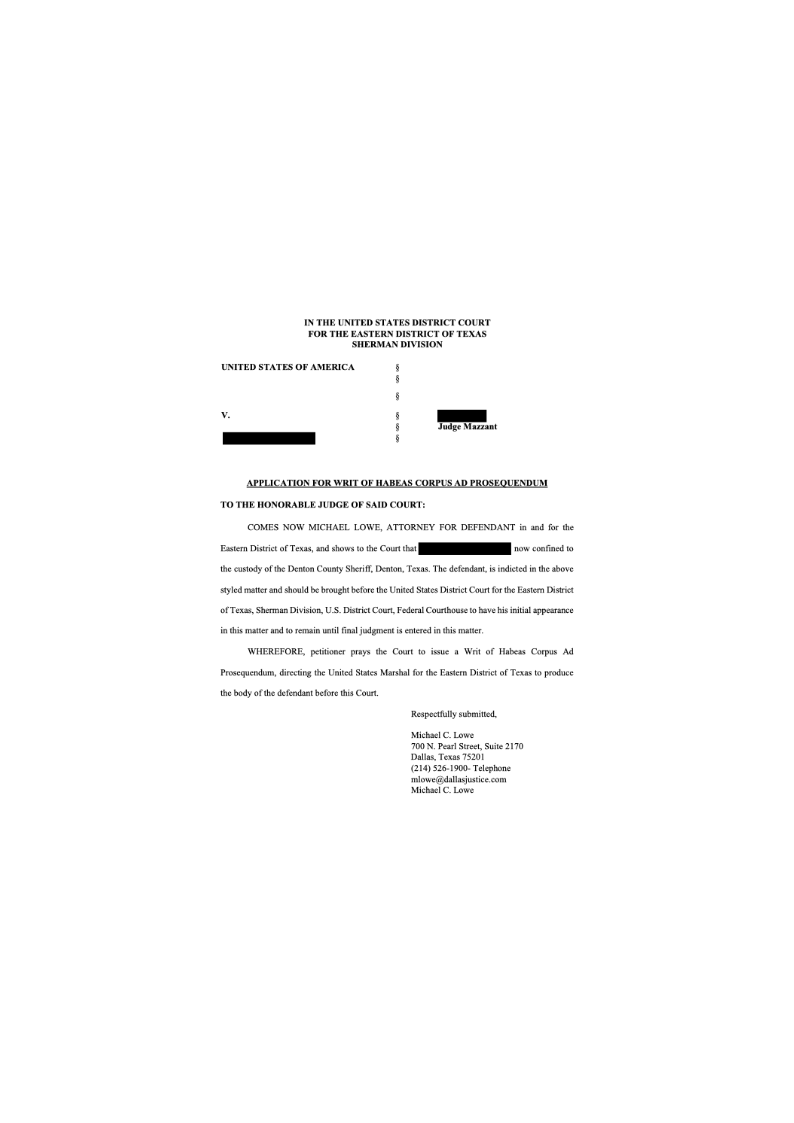
- If the US Attorney is not available or is not cooperative, I will file an Application for Writ of Habeas Corpus Ad Prosequendum. This is a motion for the Federal District Judge to issue an order to the US Marshal service to bring the subject of the federal warrant into federal custody so that they can face the charges on the federal indictment or complaint. It should look something like this:
- Once the person is brought into federal custody, I will make sure an initial appearance is scheduled. (See below)
- If the Government filed a motion to detain, I will NOT waive a detention hearing.[1] I will schedule the detention hearing. (See below)
- If the Government does not file a motion to detain, I will immediately get a bond set and get the warrant released.
- If I can prevail at the detention hearing, I will get a bond set for my client’s release at the detention hearing from the US Magistrate.
- If the Government files a motion to detain, and it appears unlikely my client can win the detention hearing (for whatever reason), I will negotiate with the US Attorney to persuade their office to withdraw the motion to detain.
Initial Appearance and Preliminary Examination in Federal Court
At the initial appearance, the US Magistrate is required to inform the defendant about the indictment or complaint and is required to give other notifications. The required time frame for a defendant to have their initial appearance in federal court after a federal arrest is governed by Rule 5(a)(1)(A) of the Federal Rules of Criminal Procedure. This rule mandates that a person arrested within the United States must be brought “without unnecessary delay” before a magistrate judge or, if applicable, a state or local judicial officer. Federal Rules Criminal Procedure R 5, United States v. Peeples, 962 F.3d 677.
In felony cases that have not been indicted, Rule 5.1 of the Federal Rules of Criminal Procedure also requires the US Magistrate to conduct a “Preliminary Examination,” which is essentially a probable cause hearing. When a defendant is arrested in a district other than the charging district, the defendant has the option of conducting the Preliminary Examination hearing in the arresting district or the charging district. See Federal Rule of Criminal Procedure 5.1. Unlike detention hearings, the Government is required to produce testifying witnesses (can include hearsay) and is also required to turn over prior witness statements to the defense counsel before the witnesses testify in accordance with Rule 26.2 of the Federal Rules of Criminal Procedure, should defense counsel request to see their statements.
Play Stupid Games, Win Stupid Prizes
For some folks, it may be tempting to simply ignore the federal US Marshal hold. I’ve heard more than one state criminal lawyer (especially state court appointed lawyers) advise their clients to ignore the federal hold and take a plea agreement on the state case. They may say something like: “Maybe if the state case is substantially similar to the federal case the feds will just go away”; Or “if you get enough time on the state case, the feds will take mercy on you and dismiss the federal charges.”
Getting sentenced on a state case when you know there are federal charges pending is the worst mistake anyone can make when they have a US Marshal hold.
Increased Sentencing Guidelines
Federal sentencing is, in part, governed by the US Sentencing Guidelines. Before every felony sentencing in federal court, the US Probation Office is required to prepare a Presentence Report and calculate the guidelines applicable to each case. The guideline sentence is arrived at based on 2 numbers: The offense level and the criminal history category. The criminal history category is calculated in USSG 4A1.1. By pleading guilty and getting sentenced on a state case, BEFORE the pending federal case has been resolved, will likely result in a higher criminal history point calculation, which may lead to a higher criminal history category and higher sentence.
This scenario would be especially harmful to someone who has no previous criminal history, because the state conviction and sentence would almost certainly foreclose the use of the “Zero Point Offender” guideline. This guideline can reduce the base offense level by 2 additional levels if the defendant has zero criminal history points.
If this situation happens, there is still hope. The USSG 4A1.2 application note 1 defines a “prior sentence” as conduct “other than a sentence for conduct that is part of the instant offense.” In other words, the guidelines are not meant to “double count” state convictions that are part of the “relevant conduct.” I can tell you from experience, that USPO and the US Attorney’s Office may not agree with you about whether the state conviction is part of the “relevant conduct.” This is not an ironclad defense.
“Stacked Sentence” or Consecutive Sentence
A federal judge has the authority to impose a consecutive (or “stacked”) federal sentence to a sentence that is pending in a state case. This authority was affirmed by the U.S. Supreme Court in Setser v. United States, 566 U.S. 231, where the Court held that federal judges have discretion to order that a federal sentence run consecutively or concurrently with an anticipated, but not yet imposed, state sentence. The Court reasoned that nothing in the Sentencing Reform Act or other provisions of law foreclosed this exercise of discretion.
The statutory basis for this authority is found in 18 USCS § 3584, which provides that federal courts generally have discretion to determine whether sentences will run concurrently or consecutively. This discretion extends to situations where a federal judge anticipates a state sentence that has not yet been imposed, as clarified in Setser.
However, the exercise of this discretion must consider the factors outlined in 18 USCS § 3553, which include the nature of the offense, the history and characteristics of the defendant, and the need for the sentence to reflect the seriousness of the offense, among other considerations. Additionally, the Supreme Court in Setser emphasized that the federal court’s decision is not overridden by a state court’s subsequent decision to impose a concurrent sentence, as federal sentencing authority operates independently under the principle of dual sovereignty.
It should also be noted that USSG 5G1.3(a) requires that the federal judge run the federal sentence consecutively to the undischarged state sentence, if it’s not part of the relevant conduct in the federal case.
Because the federal judge has broad powers to stack a federal sentence on to an existing state sentence, there is an enormous risk in getting sentenced on a state case prior to federal sentencing. If this situation happens, there are defenses that can correct the potential problem. USSG 5G1.3(b) requires that the federal sentencing judge downwardly adjust the federal sentence in accordance with time served on state sentences that make up relevant conduct and run the federal sentence concurrently with such state sentences.
Need Help With a US Marshal Hold?
If you or a loved one need help with a US Marshal Hold, please get in contact with me ASAP. As a Dallas criminal defense lawyer, I can advise you on the best course of action to take to resolve the situation.
Related Resources
I’ve written about Federal Detention hearings and the Bail Reform Act many times. You can also read more about Sealed Indictments and the job of the US Marshal Service here.
- If the government filed a motion to detain, I generally will not waive the detention hearing. Even if it seems unlikely that I can prevail, I believe it’s important to do everything possible to get my client released. However, there are times when it does not make sense to have the detention hearing. ↑
Comments are welcomed here and I will respond to you -- but please, no requests for personal legal advice here and nothing that's promoting your business or product. Comments are moderated and these will not be published.

Leave a Reply