

Co-Conspirator Hearsay: How Statements by Others Can Be Used Against You In Drug Conspiracy Cases
Posted on by Michael Lowe.
In federal drug conspiracy cases, statements made by alleged co-conspirators can be used against you at trial, even if you never heard those statements and never met the person who made them.
Under Federal Rule of Evidence 801(d)(2)(E), the government can introduce out-of-court statements by a co-conspirator that were made during and in furtherance of the conspiracy.
This means taped phone calls where someone mentions your name, text messages between other people discussing drug transactions, and recorded conversations you were never a part of can all become evidence against you in court.
This rule is one of the most powerful tools federal prosecutors have in drug conspiracy cases, and it is used regularly in the Northern District of Texas and federal courts across the country.
Understanding how co-conspirator hearsay works, what the government must prove before these statements come in, and how to challenge this evidence is critical for anyone facing federal drug conspiracy charges in Dallas or anywhere in Texas.
How Does Co-Conspirator Hearsay Work Under Federal Rule of Evidence 801(d)(2)(E)?
Co-conspirator hearsay allows the government to use statements made by one member of an alleged conspiracy against all other members, as long as the statements were made during and in furtherance of the conspiracy.
Federal Rule of Evidence 801(d)(2)(E) technically classifies these statements as “not hearsay” rather than as an exception to the hearsay rule.
That distinction matters from a legal standpoint because it means the usual concerns about out-of-court statements, such as the inability to cross-examine the person who made them, are treated by the law as if they do not apply.
In practical terms, this is how it plays out in a federal drug case: the DEA or FBI records a phone call between two people discussing a drug deal.
One of those people mentions your name, says you are involved, or refers to you by a nickname.
You were not on that call, did not know about it, and may not even know the person who said your name.
Under Rule 801(d)(2)(E), the prosecution can play that recording for the jury and argue it proves your involvement in the conspiracy.
The jury hears someone talking about you committing crimes, but you never get to question that person directly about what they said.
What Must the Government Prove Before Co-Conspirator Statements Are Admitted?
Before the court allows co-conspirator statements into evidence, the prosecution must establish three things by a preponderance of the evidence: that a conspiracy existed, that both the person who made the statement and the defendant were members of that conspiracy, and that the statement was made during the course of and in furtherance of the conspiracy.
The first requirement is proving that a conspiracy actually existed.
A conspiracy under federal law is simply an agreement between two or more people to commit a crime.
The government does not need to show a formal written agreement or even that the conspiracy succeeded.
They can point to circumstantial evidence like phone records, surveillance, financial transactions, and the testimony of cooperating witnesses who are seeking plea bargains to argue an agreement existed.
The second requirement is proving that both the person who made the statement (the declarant) and the defendant were part of that same conspiracy.
It is not enough to show that the defendant knew someone who was involved in drug activity.
The government must show that the defendant actually agreed to participate in the conspiracy, even if that participation was minor.
The third requirement, and often the most contested at trial, is showing that the statement was made “during the course and in furtherance of” the conspiracy.
Statements that further the goals of the conspiracy qualify.
This includes conversations about setting up drug deals, discussing prices or quantities, identifying roles, or arranging transportation of controlled substances.
Statements that are merely casual conversation, bragging about past crimes, or confessions of guilt after the conspiracy has ended generally do not qualify.
How Did Bourjaily v. United States Change Co-Conspirator Hearsay Law?
The 1987 Supreme Court decision in Bourjaily v. United States made it significantly easier for prosecutors to get co-conspirator statements admitted at trial, and the effects of that ruling are still felt in every federal drug conspiracy case today.
Before Bourjaily, courts followed what was known as the “bootstrapping rule.”
Under that rule, the prosecution could not use the very hearsay statements it wanted to admit as evidence that a conspiracy existed.
The government had to rely entirely on independent, non-hearsay evidence to prove the conspiracy before the statements could come in.
The Supreme Court changed that in Bourjaily.
The Court held that when a judge is deciding whether to admit co-conspirator statements, the judge can consider the hearsay statements themselves, along with other evidence, to determine whether a conspiracy existed and whether the defendant was part of it.
The Court also established that these preliminary facts only need to be proven by a preponderance of the evidence, meaning “more likely than not.”
This is a much lower standard than the “beyond a reasonable doubt” standard that applies at trial.
The practical impact is significant: the government can essentially use the statements it wants admitted as part of the proof that those statements should be admitted.
Defense attorneys in the Fifth Circuit, which covers Texas, still challenge this process, but the legal landscape heavily favors the prosecution on this issue.
What Types of Recorded Calls and Statements Come In as Evidence?
In federal drug conspiracy investigations in Dallas and throughout Texas, the most common types of co-conspirator statements that prosecutors introduce at trial come from wiretapped phone calls, text messages, and recordings made by cooperating witnesses or undercover agents.
Federal agents obtain wiretap authorization under Title III of the federal Wiretap Act, which requires them to show probable cause that specific individuals are committing specified offenses, that normal investigative techniques have failed or are unlikely to succeed, and that agents will minimize the interception of conversations that are not relevant to the investigation.
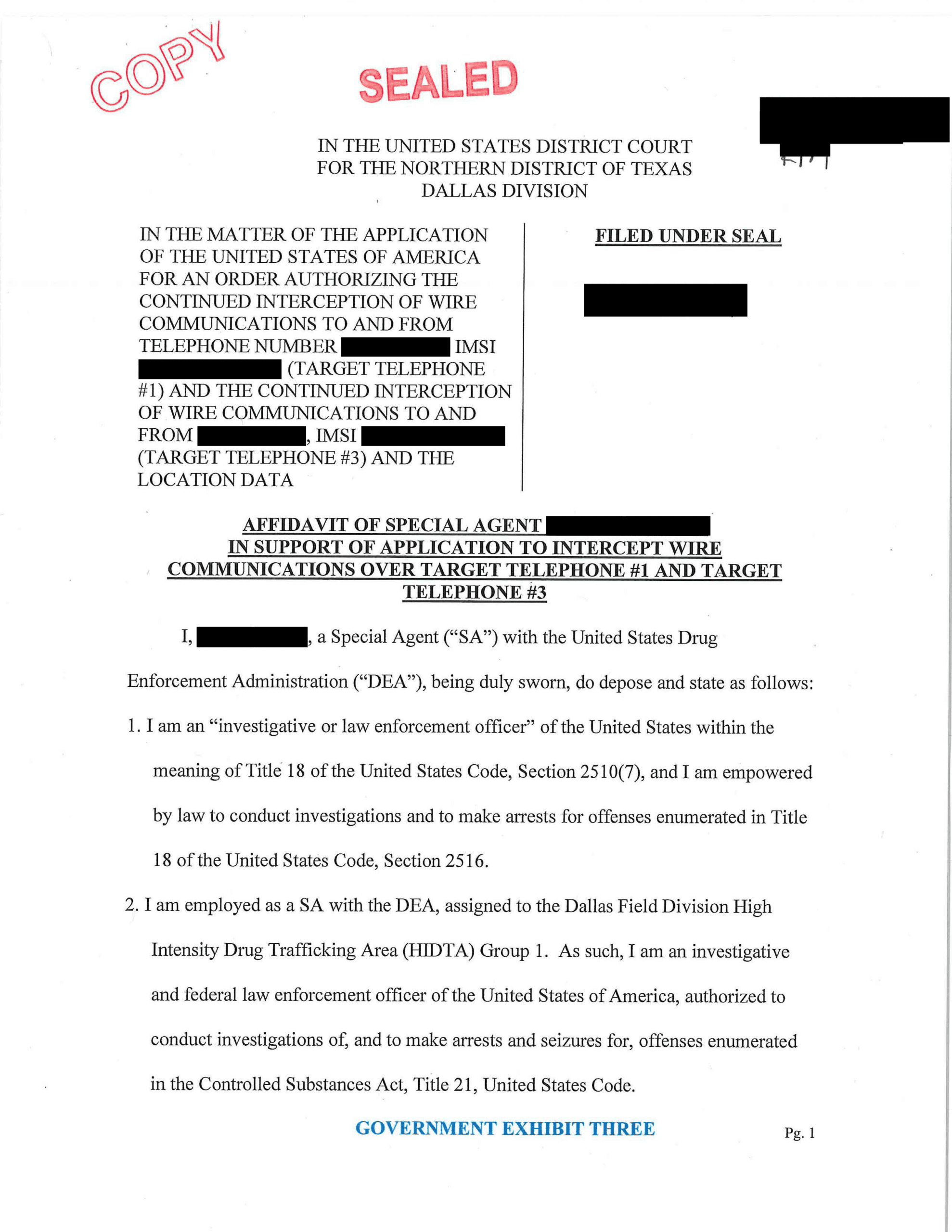
Once a wiretap is authorized, agents can record every call made to and from the target phone.
If you call someone whose phone is tapped, or if that person calls someone else and mentions your name, those recordings can end up as evidence against you.
The same applies to text messages, voicemails, and encrypted messaging app communications that agents are able to intercept.
Cooperating witnesses present another common source of co-conspirator statements.
When a co-defendant agrees to cooperate with the government in exchange for a reduced sentence, agents may have that person make recorded calls to other conspiracy members.
Those calls are designed to capture incriminating statements on tape, and they are introduced at trial under the co-conspirator hearsay rule.
In many cases, the person on the other end of the call has no idea the conversation is being recorded.
Why Is Co-Conspirator Hearsay So Dangerous for Defendants in Drug Cases?
Co-conspirator hearsay is among the most damaging forms of evidence in federal drug cases because it allows the jury to hear statements from people who may never testify and can never be cross-examined.
Cross-examination is normally the defense’s primary tool for testing the reliability of evidence.
When a witness takes the stand, the defense can challenge their memory, expose inconsistencies, reveal motives to lie, and highlight bias.
With co-conspirator hearsay, none of that is possible.
The jury hears what someone said out of court, and the defense has no opportunity to question the person who said it.
On top of that, jurors tend to give significant weight to recorded statements.
When a jury hears an actual phone call where someone is discussing a drug deal and mentions the defendant by name or nickname, the impact is powerful.
Even if the context is ambiguous, even if the defendant’s involvement is unclear from the conversation, the mere fact that the defendant’s name appears in a recorded drug conversation creates a strong impression of guilt.
Co-conspirator hearsay also expands the amount of evidence the government can present.
In a large drug conspiracy case, the government may have hundreds of recorded calls between various co-conspirators.
Even calls that the defendant was never part of can be played for the jury as long as the court finds they meet the requirements of Rule 801(d)(2)(E).
This means a defendant can face a mountain of evidence from conversations they never participated in, between people they may not know.
What Are the Best Defenses Against Co-Conspirator Hearsay Evidence?
There are several effective strategies for challenging co-conspirator hearsay in federal drug conspiracy cases, and a strong defense often targets multiple aspects of the government’s evidence.
Can You Challenge Whether a Conspiracy Existed?
The foundation of every co-conspirator hearsay argument is the existence of a conspiracy, and if the defense can show that no actual agreement existed, the statements cannot come in under Rule 801(d)(2)(E).
Prosecutors sometimes overreach by characterizing relationships as conspiracies when the evidence actually shows nothing more than a buyer-seller relationship, casual association, or isolated transactions.
A buyer-seller relationship, where one person simply purchased drugs from another without any ongoing agreement to distribute, does not automatically constitute a conspiracy under federal law.
The defense can argue that the government has failed to prove an agreement to commit a crime, which would make any alleged co-conspirator statements inadmissible.
Can You Argue You Were Not Part of the Conspiracy?
Even if a conspiracy existed, the government still must prove that the defendant personally agreed to participate in it.
Mere presence around people involved in drug activity, knowledge that illegal activity is happening, or even a friendly relationship with co-conspirators is not enough.
The defense can challenge membership by showing the defendant had no knowledge of the conspiracy’s goals, never agreed to participate, and took no actions in furtherance of any illegal agreement.
If the defendant was not a member of the conspiracy, co-conspirator statements cannot be used against them.
Were the Statements Actually Made “In Furtherance” of the Conspiracy?
Not every statement by a co-conspirator qualifies under the rule.
The statement must have been intended to advance the conspiracy’s objectives.
Statements that are merely narrative, such as bragging about past drug deals to friends, or confessions of guilt made after the conspiracy ended, do not meet this standard.
The defense should carefully review every statement the government seeks to admit and challenge those that were not made to further any conspiratorial goal.
Can You Suppress the Wiretap Evidence?
If the co-conspirator statements came from wiretapped phone calls, the defense can challenge whether the wiretap was lawfully obtained under Title III.
The government must have shown that normal investigative techniques were insufficient before seeking the wiretap, and agents must have followed minimization procedures to avoid recording non-relevant conversations.
If the wiretap authorization was defective, if agents failed to minimize properly, or if the scope of the wiretap was exceeded, the defense can file a motion to suppress all evidence obtained from the wiretap.
Suppressing wiretap evidence can remove the most damaging co-conspirator statements from the case entirely.
What Role Does the Confrontation Clause Play?
The Sixth Amendment guarantees the right to confront witnesses.
While the Supreme Court held in Bourjaily that admitting co-conspirator hearsay does not automatically violate the Confrontation Clause, there may be arguments in specific situations, particularly when the declarant is available to testify and the government is deliberately choosing not to call them.
Defense attorneys can also argue to the jury that these statements deserve less weight precisely because the person who made them was never subjected to cross-examination.
What Should You Do If You Are Facing Drug Conspiracy Charges in Texas?
If you have been charged with a federal drug conspiracy, or if you believe you are under investigation, the most important step you can take is to remain silent and contact a criminal defense attorney immediately.
Federal drug conspiracy investigations often run for months or even years before charges are filed.
During that time, the government may be collecting wiretap evidence, intercepting text messages, and building a case with cooperating witnesses.
Anything you say during this period, whether on the phone, in a text message, or in person, could become co-conspirator hearsay evidence against someone else, and their statements could become evidence against you.
Do not discuss your case with anyone other than your attorney.
Do not make phone calls from jail discussing the facts of your case, as those calls are recorded and can be used as electronic evidence against you.
An attorney who handles federal drug conspiracy cases will know how to review wiretap evidence, challenge the admissibility of co-conspirator statements, and identify weaknesses in the government’s case early enough to make a difference.
Need Help Fighting Federal Drug Conspiracy Charges in Dallas?
Co-conspirator hearsay under Federal Rule of Evidence 801(d)(2)(E) gives federal prosecutors the ability to use other people’s words against you, even from conversations you were never part of.
Defending against this type of evidence requires a detailed understanding of federal evidence law, wiretap procedures, and conspiracy defense strategies.
As a federal drug conspiracy lawyer in Dallas, Michael Lowe has extensive experience defending clients facing federal drug conspiracy charges in the Northern District of Texas and federal courts across the state.
Contact the Law Office of Michael Lowe today by calling (214) 526-1900 for a free consultation to discuss your case.
Frequently Asked Questions
What Is Co-Conspirator Hearsay Under Federal Rule of Evidence 801(d)(2)(E)?
Co-conspirator hearsay refers to out-of-court statements made by an alleged co-conspirator that the government introduces as evidence against other members of the conspiracy. Under Federal Rule of Evidence 801(d)(2)(E), these statements are classified as “not hearsay” and are admissible if made during the course of and in furtherance of the conspiracy. This means recordings, text messages, and witness accounts of what a co-conspirator said can be used against you at trial.
Can Recorded Phone Calls Mentioning My Name Be Used Against Me in a Drug Conspiracy Case?
Yes. If federal agents obtained wiretap recordings of phone calls between alleged co-conspirators, and those calls mention your name or refer to you by a nickname in connection with drug activity, those recordings can be admitted as evidence against you. The government must first show a conspiracy existed, that you were a member, and that the statements were made to further the conspiracy’s goals. You do not need to have been on the call for it to be admissible.
What Did the Supreme Court Decide in Bourjaily v. United States About Co-Conspirator Statements?
In Bourjaily v. United States (1987), the Supreme Court ruled that judges can consider the hearsay statements themselves when deciding whether a conspiracy existed for purposes of admitting co-conspirator evidence. The Court also held that the government only needs to prove the conspiracy’s existence by a preponderance of the evidence, a lower standard than beyond a reasonable doubt. This decision made it significantly easier for prosecutors to introduce co-conspirator hearsay.
How Can a Defense Attorney Challenge Co-Conspirator Hearsay Evidence?
A defense attorney can challenge co-conspirator hearsay by arguing that no conspiracy existed, that the defendant was not a member of the conspiracy, or that the statements were not made in furtherance of any conspiratorial goal. The defense can also file motions to suppress wiretap evidence if the government failed to follow proper Title III procedures. Attacking the credibility and context of co-conspirator statements at trial is another important defense strategy.
What Is the Difference Between a Buyer-Seller Relationship and a Conspiracy?
A buyer-seller relationship involves a simple transaction where one person purchases drugs from another without any ongoing agreement to distribute. A conspiracy requires an agreement between two or more people to commit a crime, along with an intent to further that criminal objective. This distinction matters because co-conspirator hearsay only applies when a true conspiracy exists, so proving the relationship was limited to buyer and seller can prevent damaging statements from being admitted.
Should I Talk to Anyone About My Federal Drug Conspiracy Case?
No. You should not discuss your case with anyone other than your defense attorney. Phone calls from jail are recorded and can be used as evidence. Conversations with friends, family, or other defendants can become co-conspirator hearsay if the government argues those statements were made during and in furtherance of the conspiracy. Exercise your right to remain silent and let your attorney handle all communication related to your case.
Comments are welcomed here and I will respond to you -- but please, no requests for personal legal advice here and nothing that's promoting your business or product. Comments are moderated and these will not be published.

Leave a Reply