

Case Result: 87.5% Sentencing Reduction in Federal Enticement Case
Achieving the Near-Impossible: A Substantial Sentencing Reduction in the Northern District of Texas
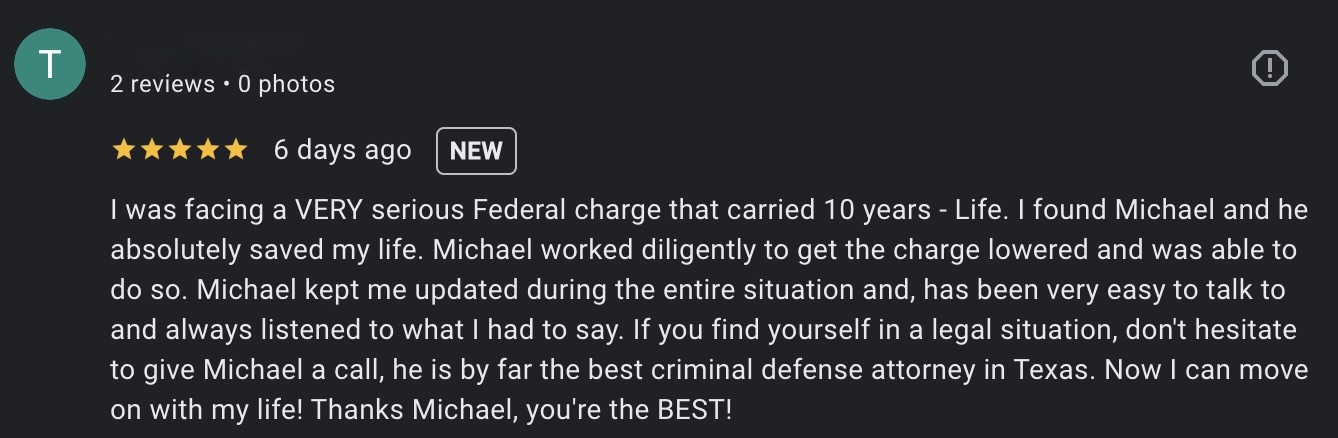
I’m pleased to share the outcome of a recent federal case that initially appeared nearly impossible to defend. My client faced serious federal charges in the Northern District of Texas, Dallas Division, for attempted enticement of a minor. Through strategic litigation and comprehensive mitigation efforts, I secured an 87.5% sentencing reduction—from a mandatory minimum of 10 years to just 15 months in prison.
The Charges and Initial Case
In March 2023, my client was arrested and charged with attempted enticement of a minor under 18 USC § 2422(b). The case began when my client initiated an online conversation via text message with someone he believed to be a 13-year-old child. In reality, he was communicating with an undercover law enforcement officer. These conversations continued on his personal phone for nearly three months.
Eventually, my client agreed to meet the person he believed to be a minor for what appeared to be a sexual or romantic encounter. Upon arriving at the designated location, he was immediately arrested.
State to Federal Charges
Initially, my client faced state charges for online solicitation of a minor under Texas Penal Code 33.021, which carries a punishment range of 2 to 20 years in the Texas Department of Criminal Justice. However, the situation escalated when federal authorities became involved. A federal grand jury in the Northern District of Texas indicted my client on the more serious federal charge of attempted enticement.
After surrendering my client to federal custody, I successfully secured his release on bond from the federal magistrate in Dallas.
Understanding the Severity of the Original Charge
A conviction under 18 USC § 2422(b) carries devastating consequences: a sentencing range of 10 years to life in prison. Under the federal sentencing guidelines (USSG 2G1.3), my client faced:
- A base offense level of 28
- A 2-level enhancement under 2G1.3(b)(3) for using a computer
- After acceptance of responsibility and as a zero-point offender, a guideline range of 57-71 months
However, the mandatory minimum statute required the judge to impose at least 10 years in prison, regardless of the guidelines. For my client, an older retired individual who had been prominent in the Dallas law enforcement community, this mandatory minimum sentence would have effectively been a life sentence.
The Defense Strategy: Mitigation and Negotiation
From the moment my client retained my services, I implemented a comprehensive mitigation plan designed to demonstrate his potential for rehabilitation and reduce his exposure.
Treatment and Evidence Gathering
I immediately guided my client into appropriate treatment programs that would not only address the underlying issues but also demonstrate his commitment to change. By strategically delaying the federal criminal proceedings, I provided my client with sufficient time to make substantial progress in his treatment.
Simultaneously, I gathered crucial mitigation evidence that would support our arguments in court and during negotiations with the prosecution.
Negotiating a Plea Agreement
Through persistent and strategic negotiations with the US Attorney’s Office over an extended period, I successfully persuaded prosecutors to reduce the charge against my client to a significantly lesser offense: Attempted Transfer of Obscene Materials to a Minor under 18 USC § 1470.
This plea agreement represented a critical turning point in the case, replacing the mandatory 10-year minimum with a 10year statutory cap.
The New Sentencing Framework
Under the negotiated plea to 18 USC § 1470, my client’s sentencing calculations changed dramatically:
- Base offense level of 10 under USSG 2G3.1(a)
- A 7-level enhancement for distributing obscene materials under 2G3.1(b)(1)(E)
- An additional 2-level enhancement for using a computer under 2G3.1(b)(3)
- After reductions for being a zero-point offender and acceptance of responsibility, his total offense level was 14
This resulted in a guideline range of just 15-21 months in prison—a dramatic reduction from the original mandatory minimum.
Overcoming Sentencing Obstacles
Despite this favorable plea agreement, significant challenges remained at sentencing. The probation department recommended an upward variance, arguing that the plea agreement was too lenient and didn’t fully account for my client’s conduct.
More concerning, the US Attorney’s Office filed a motion for an upward departure, requesting a 96-month (8-year) sentence —far above the guidelines and approaching the original mandatory minimum.
The Sentencing Result
After presenting compelling mitigation evidence and arguing forcefully against the government’s request for an upward departure, the judge sentenced my client to only 15 months in prison—the bottom of the guideline range.
This sentence represents an 87.5% reduction from the 10-year mandatory minimum my client would have faced if convicted at trial on the original charge.
Time Actually Served
Under federal sentencing rules, prisoners sentenced to more than one year do not serve their sentences day-for-day. With good time credit, it’s entirely possible that my client will be released after serving approximately 9-10 months of his 15month sentence.
Key Takeaways
This case demonstrates several critical principles in federal criminal defense:
- Early intervention matters: Immediate implementation of treatment and mitigation strategies can significantly impact case outcomes.
- Strategic timing: Carefully managing case timelines can provide defendants the opportunity to demonstrate genuine rehabilitation efforts.
- Persistent negotiation: Building a strong mitigation case can persuade prosecutors to consider reduced charges, even in serious federal matters.
- Comprehensive advocacy: Success requires fighting on multiple fronts—negotiating favorable plea agreements and then defending against government attempts to seek harsher sentences.
Even cases that appear impossible to defend can yield favorable results with the right strategy, preparation, and advocacy. If you or a loved one is facing serious federal charges, experienced legal representation can make all the difference in the outcome of your case.
Comments are welcomed here and I will respond to you -- but please, no requests for personal legal advice here and nothing that's promoting your business or product. Comments are moderated and these will not be published.

Leave a Reply