

How to Defend a Manufacture Delivery Charge in Texas: 10 Critical Things You Need to Know
Posted on by Michael Lowe.
A comprehensive guide to manufacture delivery defenses in Texas from a Board Certified Criminal Defense Attorney with 27+ years of experience
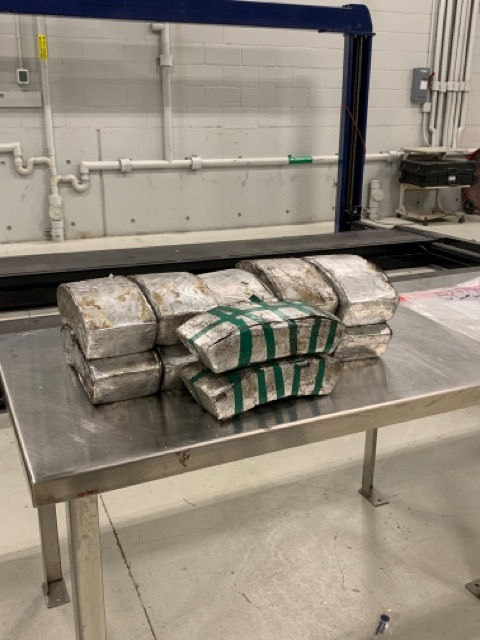
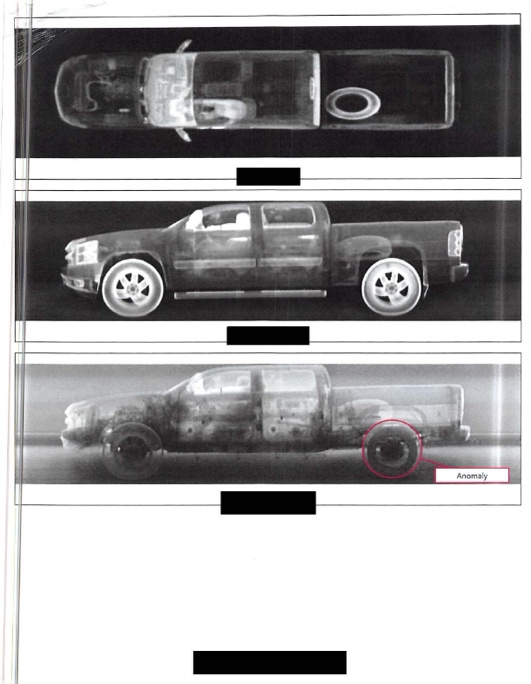
Left: Seized drug evidence in a Texas trafficking case | Right: X-ray scan revealing hidden vehicle compartment
“`html
What is the definition of manufacture delivery charges in Texas?
“`
If you’re wondering how to defend a manufacture delivery charge in Texas, you’re not alone. As a Texas Board Certified Criminal Defense lawyer who has defended individuals facing drug crime charges throughout the State of Texas for over 27 years, I’ve seen countless defendants confused and overwhelmed by these serious charges.
I’ve come to believe that both criminal lawyers and their clients would be better served if they understood the key manufacture delivery defenses in Texas. Here are the ten critical things anyone facing a manufacture or delivery charge needs to know about defending their case.
1. Understanding Your Actual Charge
The first thing that happens when someone gets arrested on a larger state drug case is they see their charge in the jail. Often, that charge is listed as “Manufacture or Delivery of a Substance” in Penalty Group 1, 1-A, 1-B, 2, 2-A, 3, or 4.
Here’s the truth: there is no such criminal charge in Texas. This name is simply the title of Article 481 of the Texas Health and Safety Code applicable to the penalty group containing the substance. For example, Section 481.112 is entitled “Manufacture or Delivery of Controlled Substance in Penalty Group 1.”
This is the most common section since it refers to Methamphetamine, Cocaine, Heroin, and other Group 1 substances. The District Attorney will most likely charge you with one of three offenses:
- Possession with Intent to Deliver
- Delivery of a Controlled Substance
- Manufacturing a Controlled Substance
If you don’t know which penalty group your case falls under, you can search for the substance in the Texas Health and Safety Code Chapter 481.
Texas Controlled Substances Penalty Groups Reference Chart
To make it easier for you, I’ve created a searchable reference chart for each controlled substance in Texas. Here’s a comprehensive breakdown:
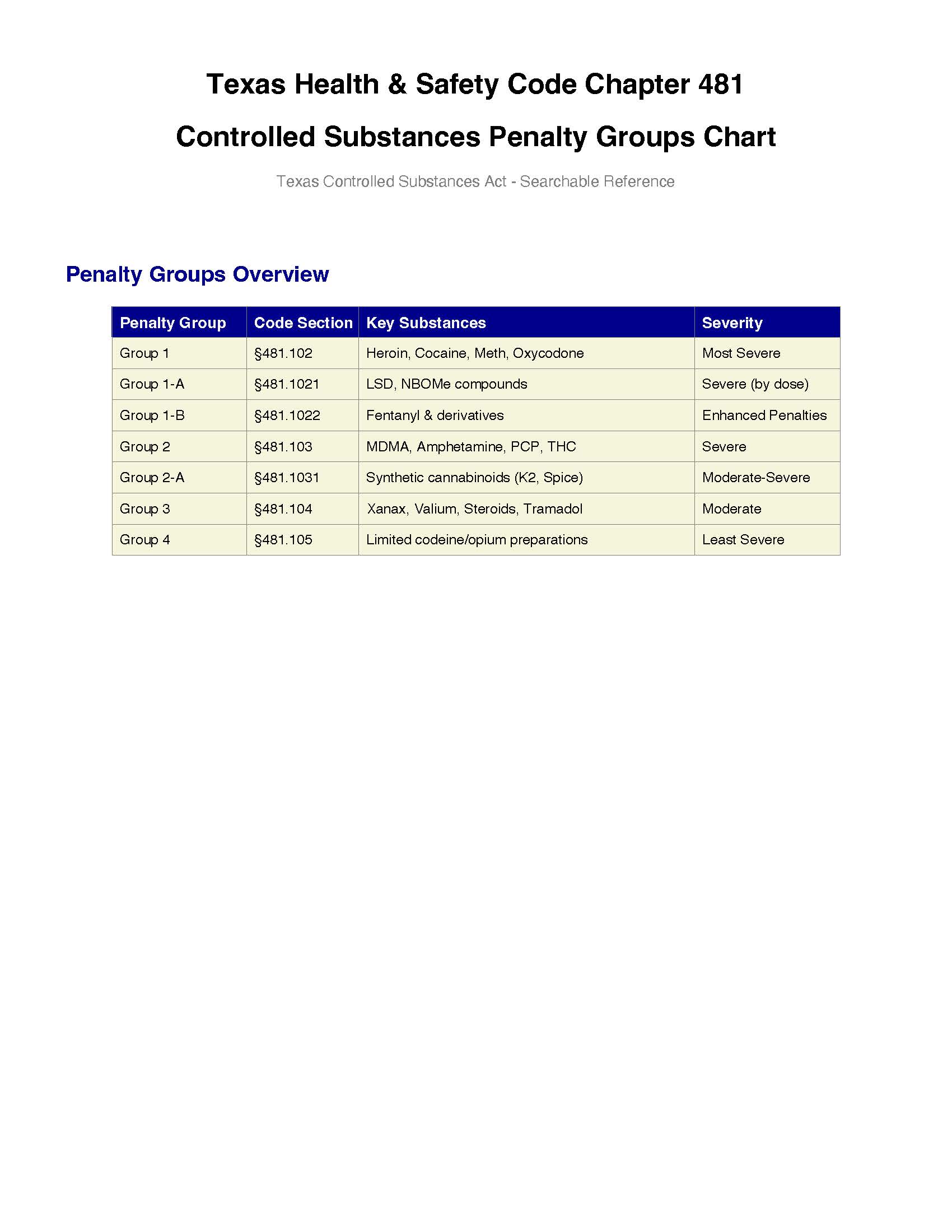
Texas Penalty Groups Overview – Code sections and severity levels for all drug penalty groups
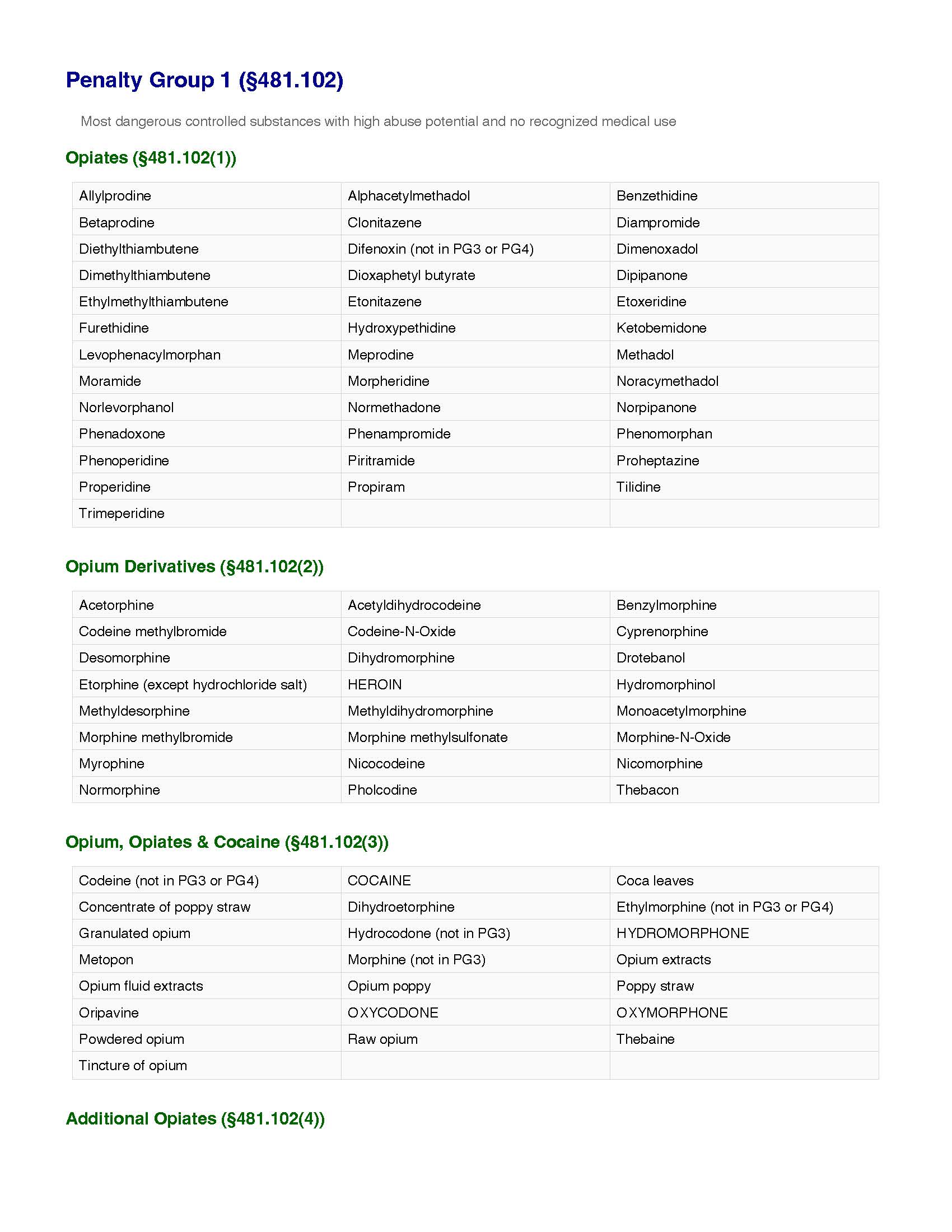
Penalty Group 1 – Opiates, Opium Derivatives, and Cocaine
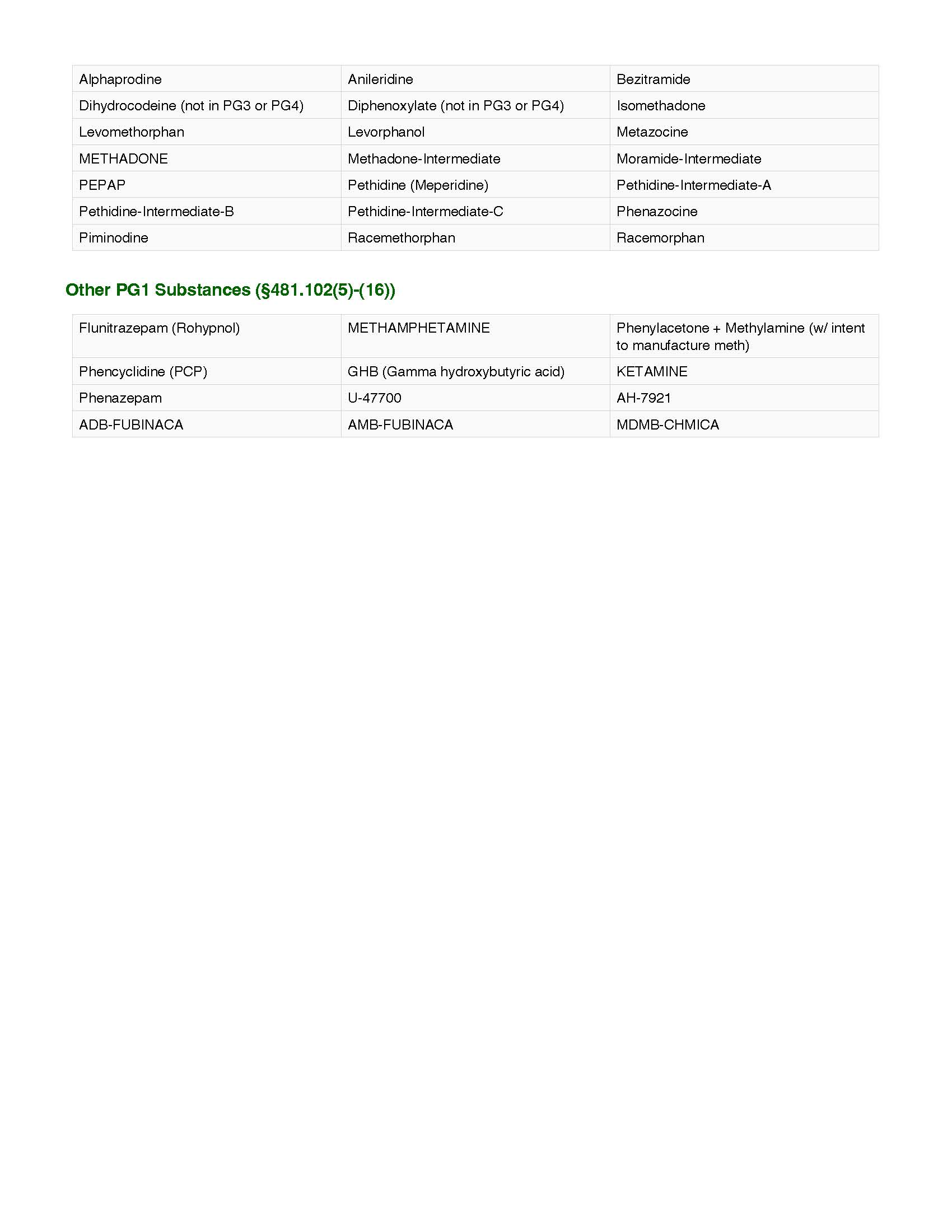
Penalty Group 1 (continued) – Methamphetamine, Ketamine, and other PG1 substances
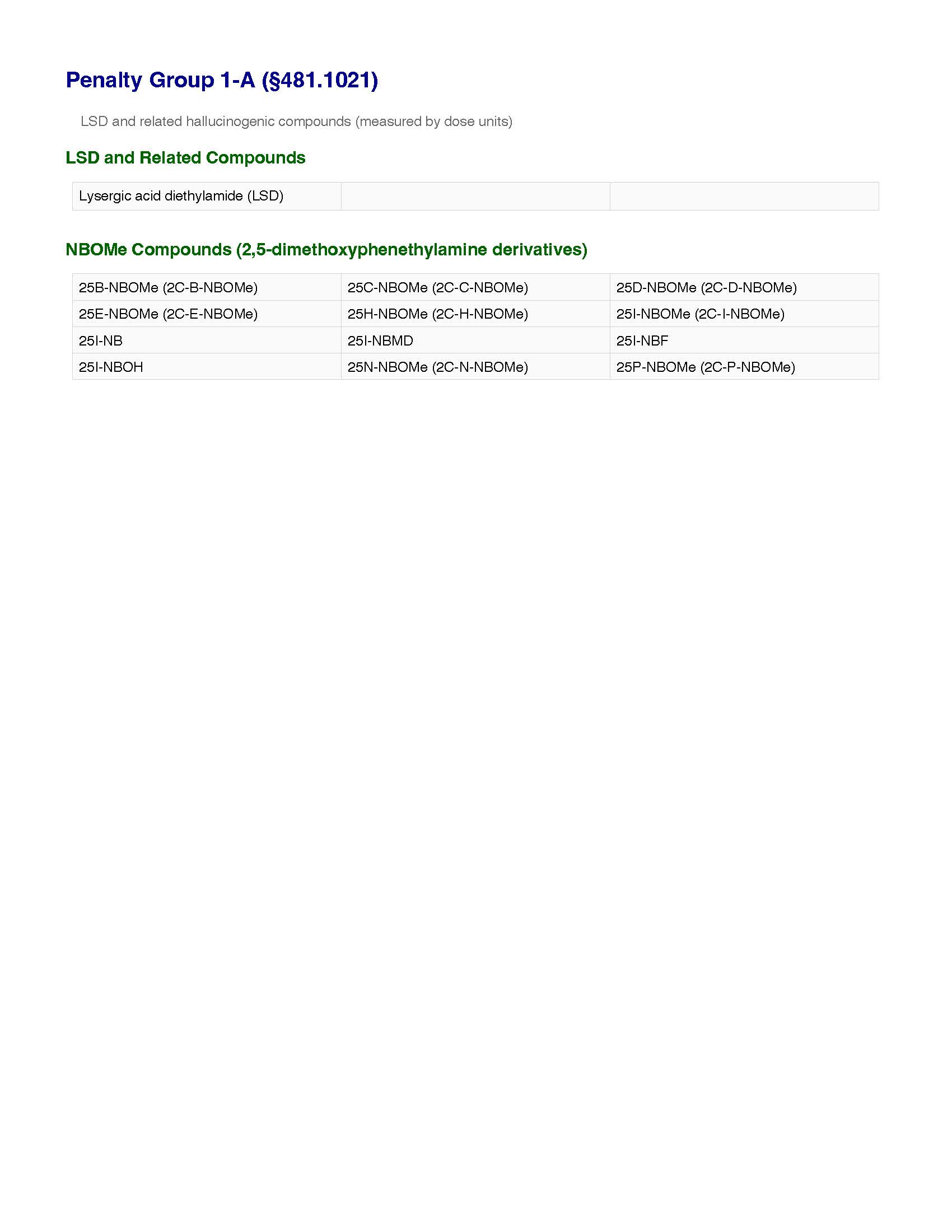
Penalty Group 1-A – LSD and NBOMe Compounds
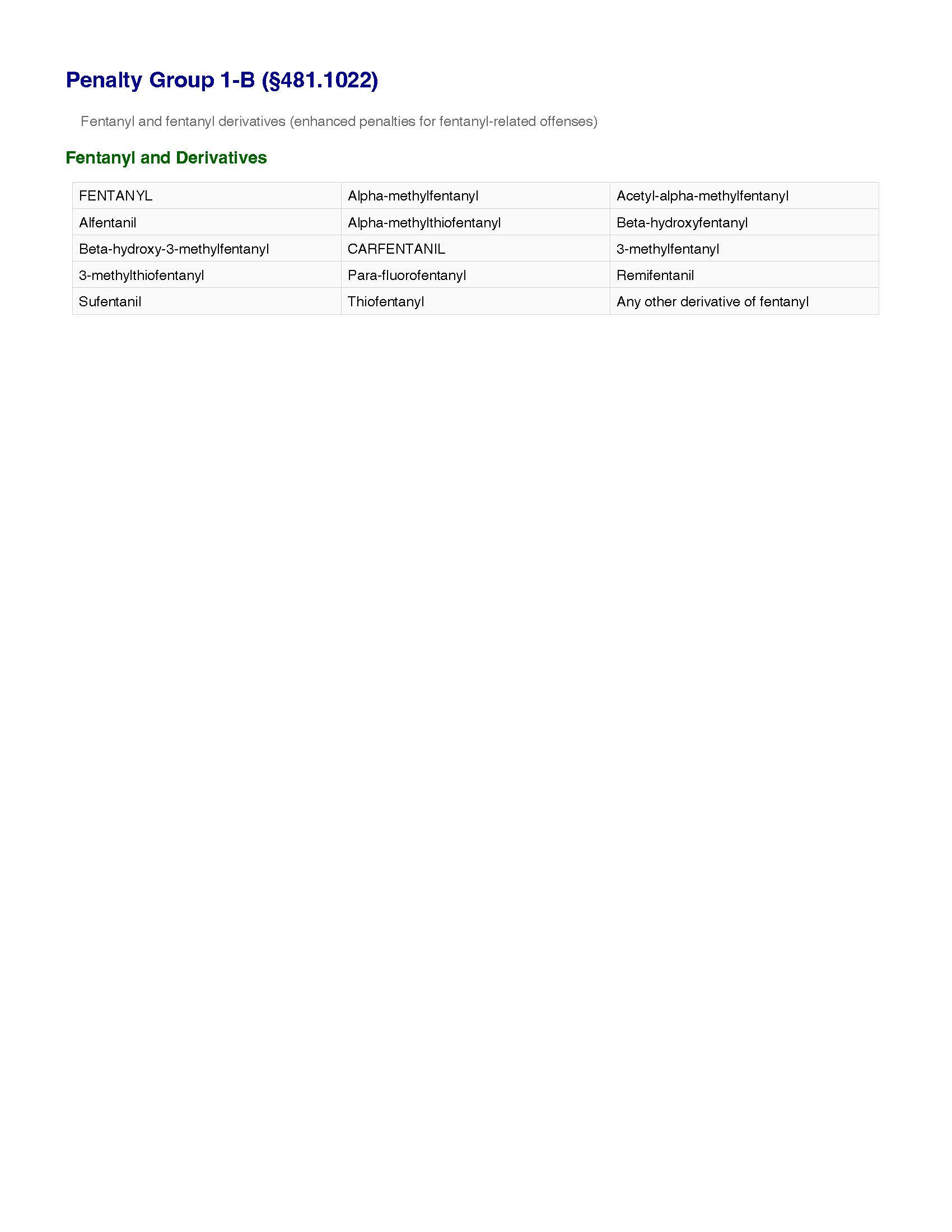
Penalty Group 1-B – Fentanyl and All Fentanyl Derivatives
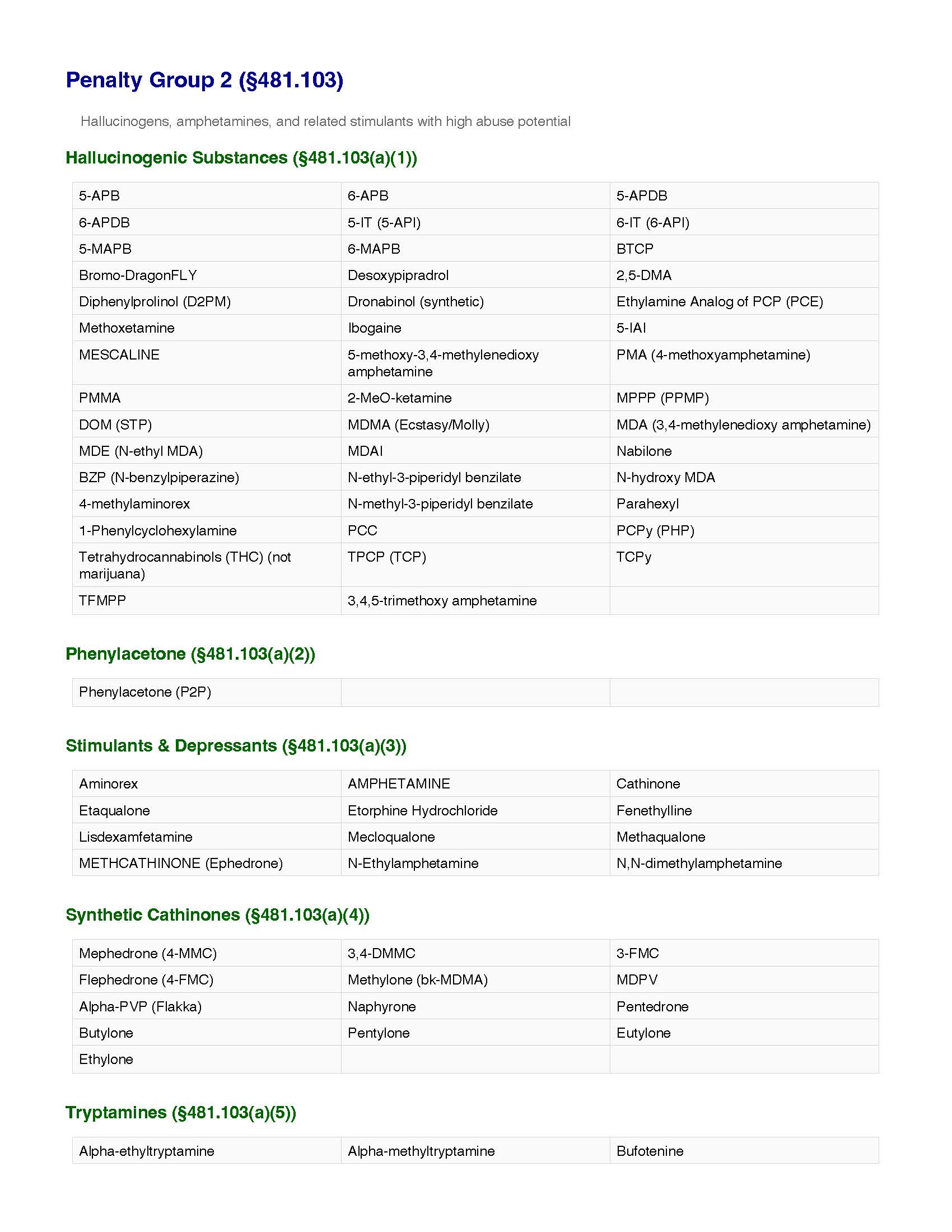
Penalty Group 2 – MDMA, Amphetamines, and Hallucinogens
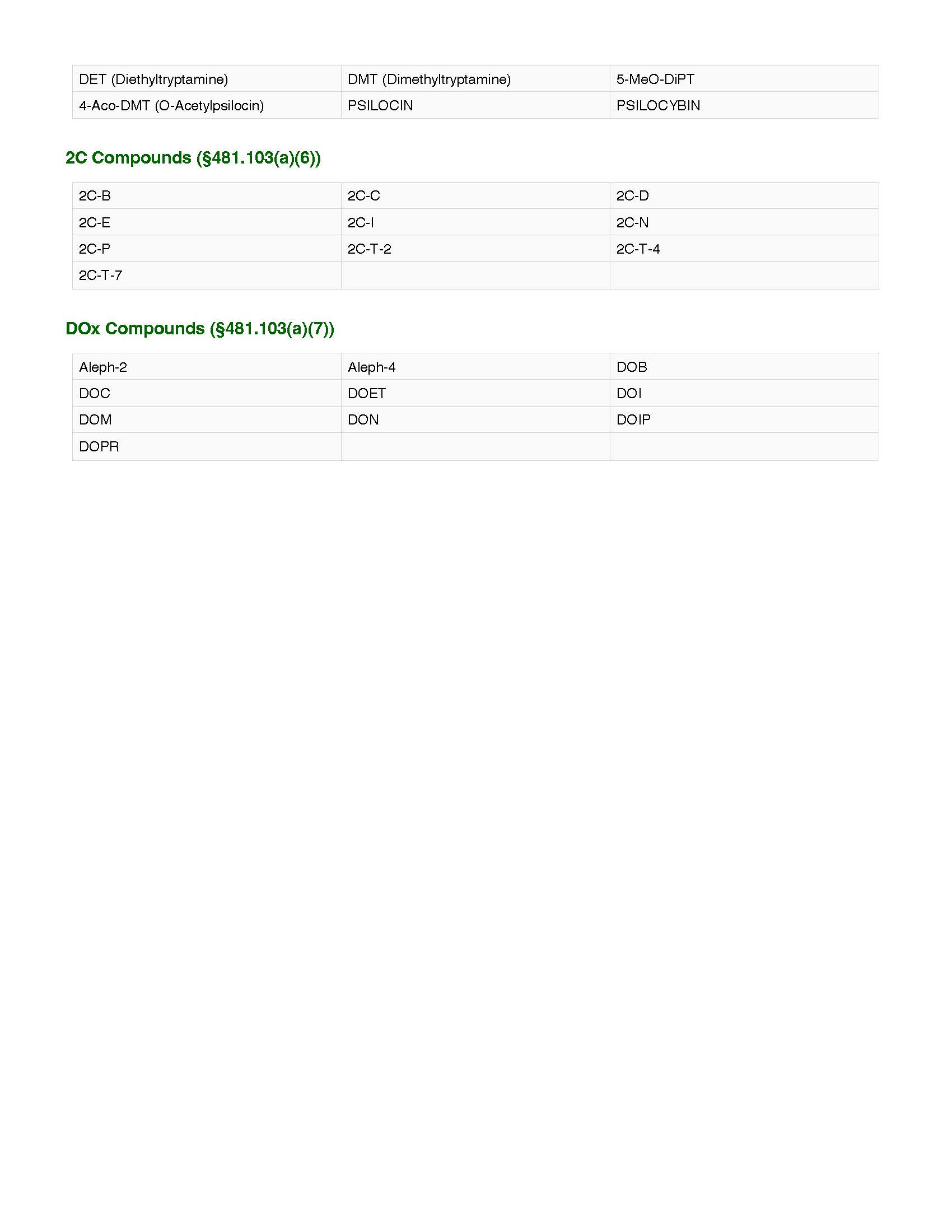
Penalty Group 2 (continued) – Synthetic Cathinones, Tryptamines, and 2C Compounds
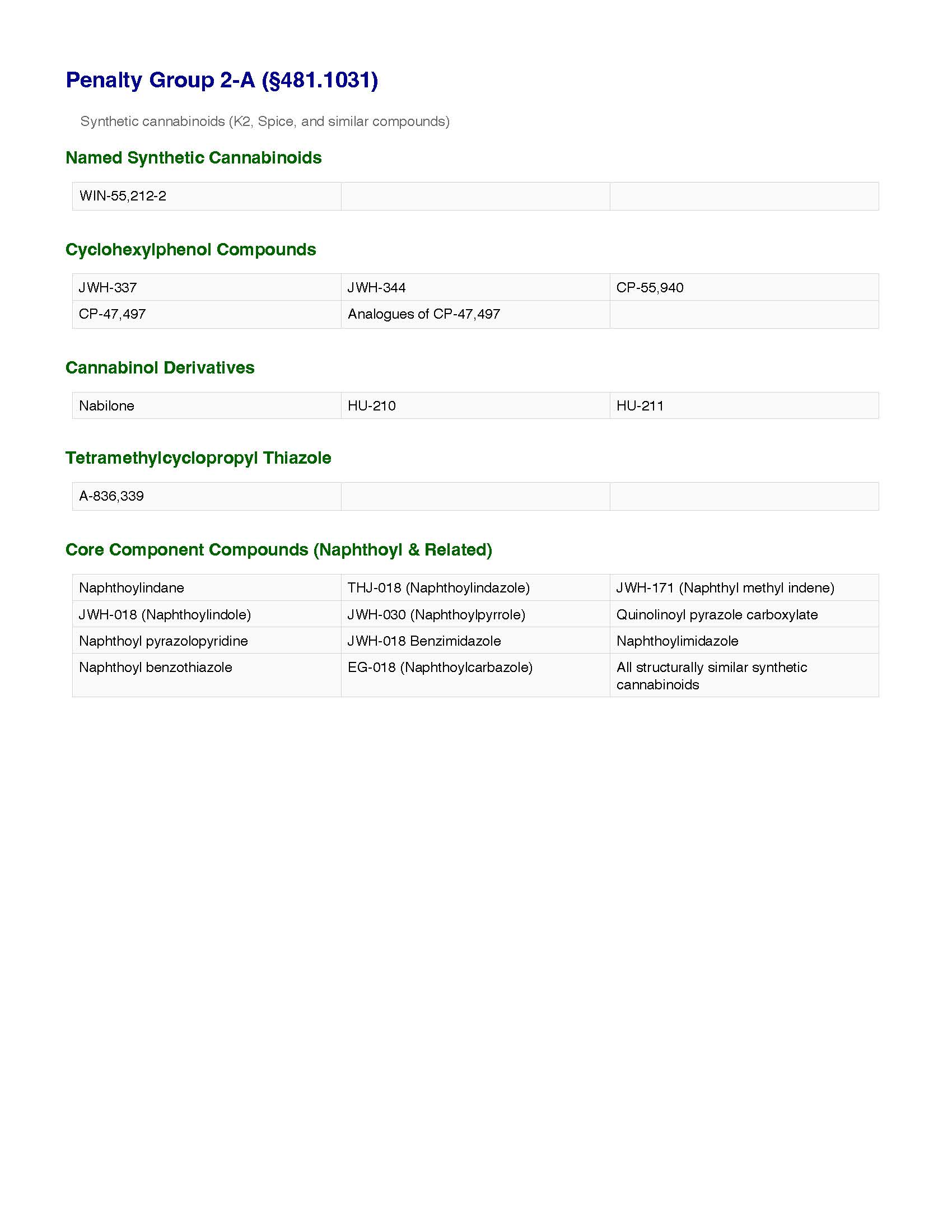
Penalty Group 2-A – Synthetic Cannabinoids (K2, Spice, JWH compounds)

Penalty Group 3 – Benzodiazepines (Xanax, Valium, Klonopin)

Penalty Group 3 (continued) – Barbiturates, Sedatives, and CNS Stimulants

Penalty Group 3 (continued) – Anabolic Steroids
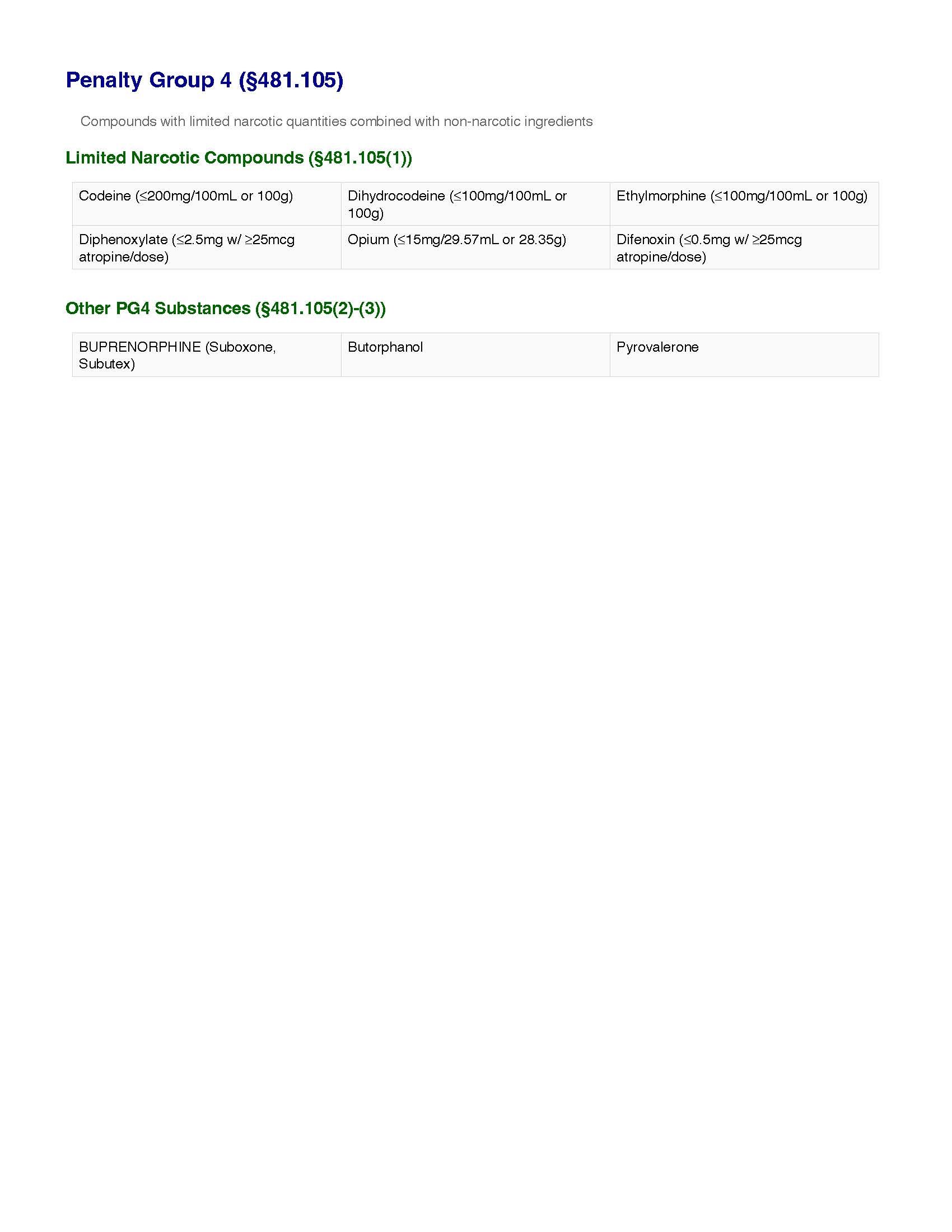
Penalty Group 4 – Limited Codeine Preparations and Buprenorphine

Important Notes About Texas Penalty Groups
2. Know Your Range of Punishment
This may seem obvious, but you’d be surprised. I once appealed a case to the Dallas Court of Appeals because the trial defense lawyer’s client was eligible for probation, but the lawyer didn’t discover that fact until he stood up to give his closing argument. He voir dired the jury on the wrong range of punishment and didn’t qualify anyone on probation.
Understanding the range of punishment is critical for manufacture delivery defenses in Texas because there are numerous scenarios where a judge, jury, or both cannot consider probation or even deferred adjudication. The TDCAA has a good chart to help keep track of different ranges of punishment on all drug cases.
Drug Free Zone Complications
The range of punishment gets much more complicated when Drug Free Zones, enhancement paragraphs, and deadly weapons are involved. A 481.134 drug free zone can:
- Increase the level of penalty by one level for most charges
- Increase the minimum on first degree from 5-99 or Life to 10-99 or Life
- Require the judge to run the sentence consecutively (“stacked”) with all other sentences
- Severely affect parole rights
Texas Government Code 508.1459(e) requires that the first five years served in prison are served as ACTUAL CALENDAR TIME. If the prison sentence is less than five years, parole is NOT AVAILABLE. This is a huge difference from normal parole rules, which allow parole in drug cases to start at only one-quarter of the sentence.
3. Don’t Snitch!
I have known quite a few local and DPS narcotics detectives both as a former Organized Crime Prosecutor and as a Defense Lawyer. I know that these detectives are trained in the art of deception. They are professional liars.
They will tell you whatever they think you want to hear. They will play on your desperation because they know you just got arrested and you think your life is over if you don’t play ball.
Don’t do it! The detective has no authority to make any deals with the DA’s office. It will be up to the District Attorney assigned to your case to decide what to do. For example, the Dallas County District Attorney’s Office will not even recognize any cooperation you’ve done unless they have explicitly approved of it and their procedures are followed.
Does this mean you should never cooperate with the State? No. You need a good lawyer who knows how to handle cooperation in a way that actually benefits you.
4. A Confidential Informant (CI) is Probably Involved
In my experience, almost every single “Possession With Intent to Deliver” or “Delivery” case involves a confidential informant. Yet, most police reports simply do not mention this fact at all.
The most common scenario involves the confidential informant being brought into the investigation AFTER the arrest has been made. This technique allows the police to obtain the incriminating evidence they need and also keep the snitch off of the police report. This is where your drug crimes lawyer can make or break your case—you NEED to find out who the snitch is.
5. Discover the Informant’s Identity
Easier said than done, right? Not really. Most of the time, you know who the snitch is. In these cases, you NEVER want to tell anyone that you really know who the snitch is. If the State finds out you know, they won’t need to protect the informant’s identity—which can be worth a lot later at the courthouse.
Giving up the informant can be the difference between a 1st degree felony Possession With Intent to Deliver case and a Misdemeanor case. I know because I’ve done it many times before.
What if you don’t know who the snitch is? Your lawyer needs to somehow make the snitch a “fact witness” to your case. Texas Rule of Evidence 508 permits the court to conduct an in camera hearing to determine whether there’s a reasonable probability the informant can give testimony on facts concerning the guilt or innocence of the defendant.
I’ve filed a Motion to Discover the identity of the informant many times. Here is an example from a case I handled in Collin County:
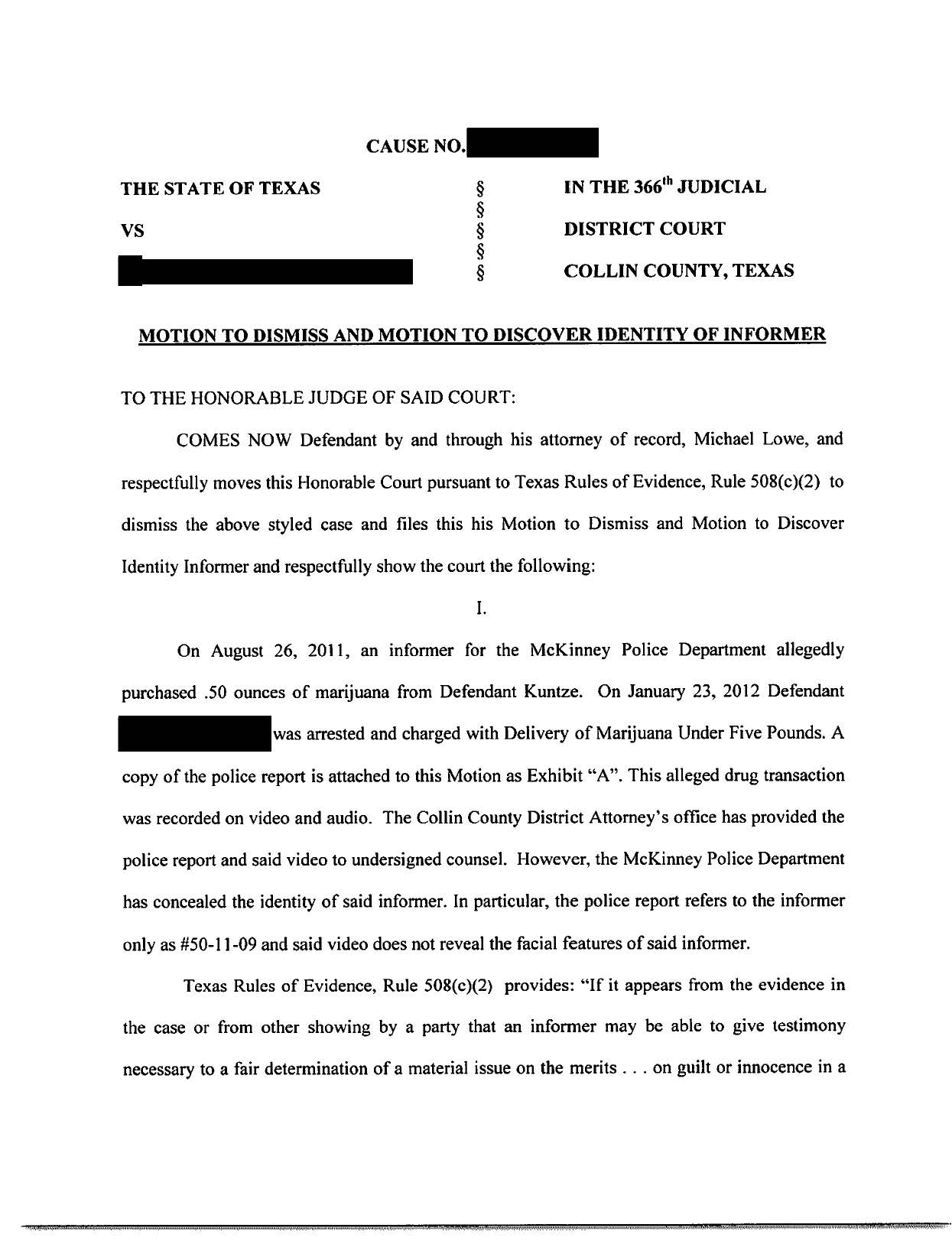
Motion to Dismiss and Motion to Discover Identity of Informer – Page 1
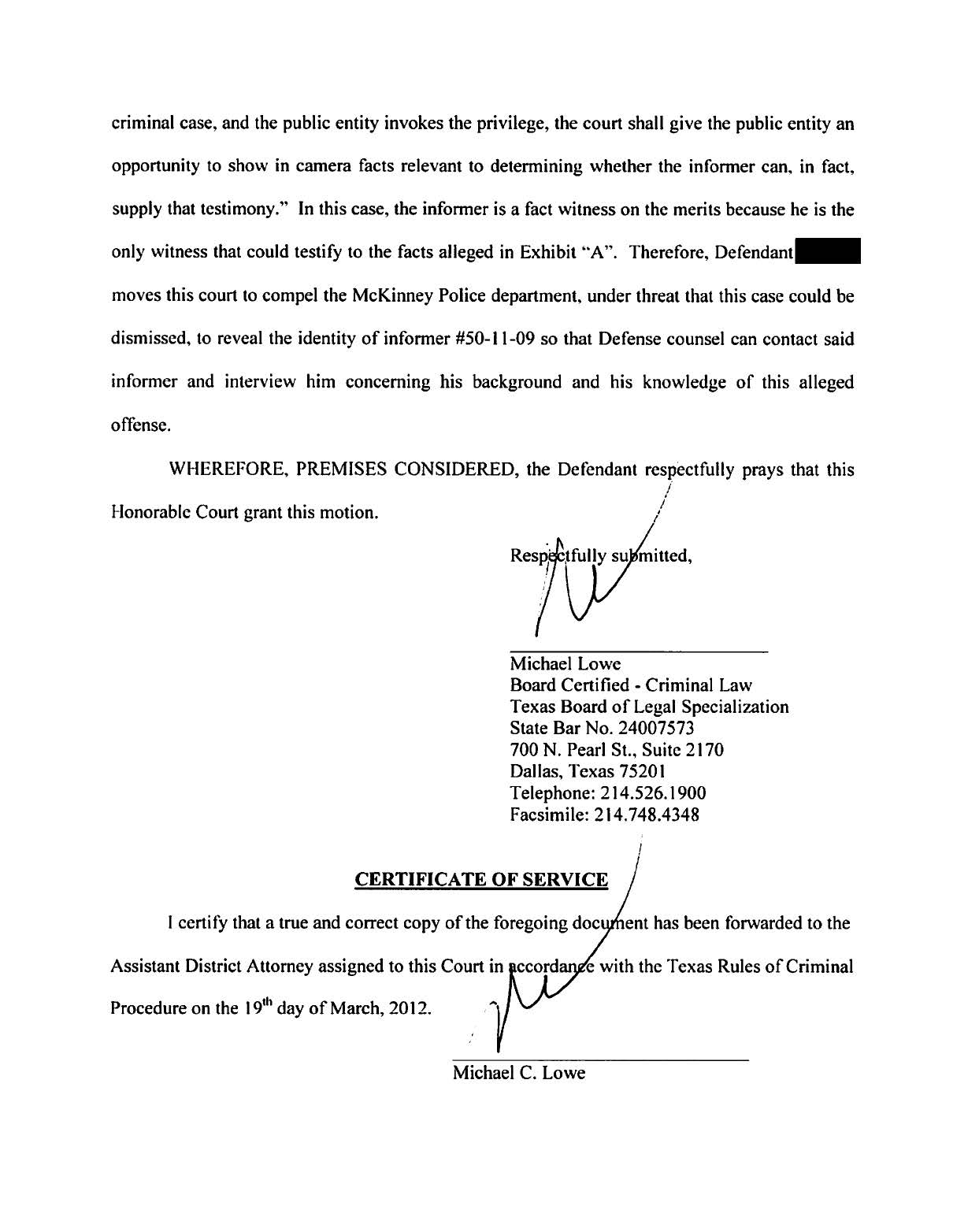
Motion to Discover Identity of Informer – Page 2
6. Take Advantage of the Examining Trial
You will be entitled to an examining trial in Texas state court prior to indictment. This is a probable cause hearing where your lawyer has the right to cross-examine the State’s witness.
Sometimes, the examining trial can be used to subpoena additional state witnesses and get their testimony on the record very early in an investigation. The DA’s office is mostly not prepared for these hearings. An experienced defense lawyer can ruin their case in about 15 minutes.
7. Fully Understand All Search, Detention, and Arrest Issues
This is a very complex area of law that is crucial for understanding how to defend a manufacture delivery charge in Texas. Your lawyer needs to be up to date on all relevant detention, search, and arrest case law. Many cases have been won or lost based solely on Fourth Amendment issues.
8. Beware of the Slow Plea!
What is a “slow plea?” Texas is one of the few states that gives the defendant the right to be sentenced by their peers. Jury sentencing can be a huge advantage for the defendant, especially in drug cases. A slow plea is a plea of guilty in front of a jury with an election for jury punishment. A lawyer might recommend that the client do a slow plea if the attorney thinks a not guilty is impossible. The “theory” is that the jury will appreciate the guilty plea and give the defendant “credit” for it in sentencing.
There are two basic advantages to jury sentencing:
- Juries can be more sympathetic to drug addiction problems
- The “spillover effect” – juries like to make deals so they can go home
Texas judges hear it every day. Over time, they become hardened to these pleas. The truth is many judges aren’t even paying attention when the defendant is addressing the court or worse—they are texting the prosecutor pointers on how to better prosecute their case.
As a former prosecutor, one of the games my colleagues and I used to play was to drop a Possession With Intent to Deliver Penalty Group I controlled substance 400 grams or more case (a 15 to Life case) down to a 4 to 200 grams case (a 5 to Life case) in exchange for a slow plea. A defense lawyer might recommend that the client agree to such a deal because it makes the client eligible for probation because the minimum is less than 10 years.
The catch? The spillover effect is now gone. The jury has NO DOUBT that the defendant is really guilty and can be primed to give out a Life sentence. I have seen more Life sentences handed out on drug cases after a slow plea than any other type of defense. Watch out for the slow plea!
9. Find a Lawyer Who Has Tried Many Drug Cases
This should be obvious, but most lawyers have never even tried a higher-level drug trafficking offense. These cases are very different from assaults or other violent crimes. I have tried more than 50 of these types of cases and have learned what works and what doesn’t when it comes to manufacture delivery defenses in Texas.
10. Don’t Panic; Plan It
It takes a lot of time to prepare these cases. I can and will answer all of your questions over the phone, but don’t ask me to make any miraculous guarantees during a five-minute phone call. I’ll leave that up to the amateurs.
Just look at my track record, experience, and qualifications. You have all the answers you need.
Watch Dallas criminal defense attorney Michael Lowe explain the 10 things you must know about defending Texas manufacture or delivery charges.
Need Help With a Manufacture Delivery Case?
If you or a loved one need help with a manufacture delivery case, please get in contact with me ASAP. As a Dallas criminal defense lawyer, I can advise you on the best course of action to take to resolve the situation.
Comments are welcomed here and I will respond to you -- but please, no requests for personal legal advice here and nothing that's promoting your business or product. Comments are moderated and these will not be published.
5 Responses to How to Defend a Manufacture Delivery Charge in Texas: 10 Critical Things You Need to Know
 Rodrick Bell says:
 I had a charge 14yrs. Ago poss w/intent to deliver off of a officer searching my car stating I wasn’t wearing a seatbelt and i had illegal tint and i possessed paraphernalia “cigars & small bags” which were in a small paper bag. In short i requested a jury trial for a year and was refused even after expressing this to the judge. I was told by the judge that if i went to trial i was going to receive nothing less than 25yrs. I end up copping for 10yrs which i completed 2012. My point is without the right amount of money there is no win….period. That was my first drug case without having any charge in 10 years.
 Janise Alcorta says:
 can a case be dismissed for conflict of interest if the prosecuter is married to the officer head who signed off on a set up for a manufacturing and delivery charge?
 Beverly Ann bowling says:
 Please help
 Lakomanesha N Love-Hall says:
 Can I ask if 44 grams of Fentanyl-sentencing 30 years with 15 mandatory a good offer?

Generally speaking, in an examining trial for a case involving drugs/controlled substances, can the State successfully convince a judge to find probable cause even where it only has officer testimony concerning a field test because the laboratory results have not been completed?