

Ring Camera Proves Alibi Defense in Tarrant County Aggravated Assault/Deadly Weapon
Michael Lowe’s client was accused with Aggravated Assault with a Deadly Weapon in Tarrant County. The father of her child was the complaining witness. Late last year, Mr. Lowe’s client was assaulted by the complaining witness. He was arrested and charged with Assault/Family Violence in Tarrant County. The child’s father continued to have contact with Mr. Lowe’s client despite an Emergency Protective Order and a bond condition stay away order. Both of these court orders prohibited him from contacting her or being around her or her residence.
While his case was pending in Tarrant County, he harassed and threatened to trap and unlawfully restrain Mr. Lowe’s client in her own home. The Ex took her car keys and phone away from her. Because she couldn’t call the police, she left her home on foot and walked to her cousin’s home seeking safety and refuge. Her cousin’s home was about 1 mile away. When Mr. Lowe’s client got to her cousin’s home, the client rang her cousin’s door bell to see if she was home. Just a month earlier, her cousin installed a Ring doorbell and activated the Ring app to monitor her home. The Ring device recorded the movement at the door which clearly showed the time Mr. Lowe’s client arrived at the residence about a mile away from the client home (where the Ex was). The Ring video footage clearly demonstrated the exact time the client arrived by foot. In addition, the Ring app logged all activity to/from the house for the entire day. You can see the redacted log here:
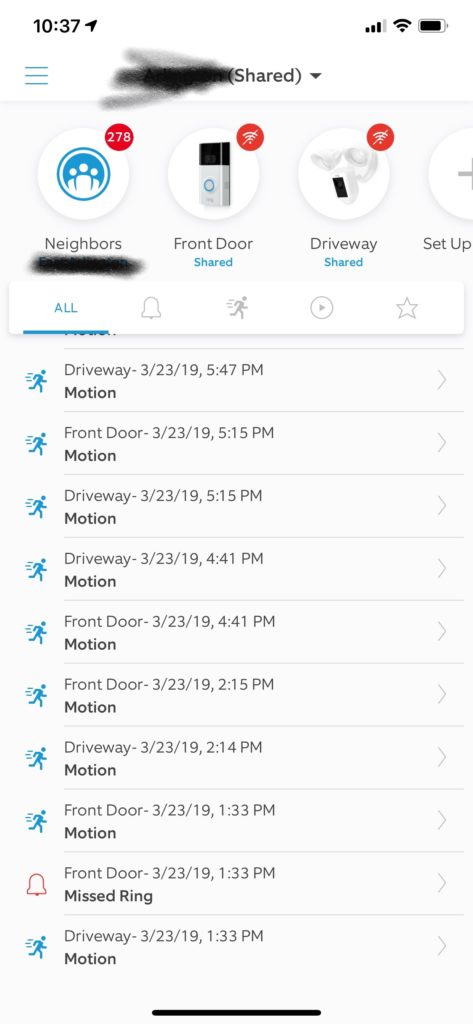
While Mr. Lowe client was at her cousin’s home, her Ex called 911 from her home. When the police arrived, the Ex falsely reported that he had been assaulted 20 minutes before their arrival. He claimed that the client assaulted him with a knife. Without conducting a complete investigation, the police arrested the client and charged her with Aggravated Assault with a Deadly Weapon (knife).
Shortly after the arrest, the client hired Mr. Lowe. Mr. Lowe conducted a thorough investigation of his own. He obtain all of the police records including the 911 recording. Mr. Lowe was able to conclusively establish the exact time of the alleged Assault. Mr. Lowe then interviewed additional witness and was able to recover the Ring App data along with all video recordings made on the date of the alleged Aggravated Assault with which his client was charged. Mr. Lowe was able to conclusively demonstrate that his client was not able to have assault the Ex as he falsely described to the police. Mr. Lowe then made contact with the Tarrant County District Attorney assigned to his client’s case and submitted a grand jury packet which included all of the Ring videos and app data. In addition, Mr. Lowe was able to provide witness statements corroborating the data provided. In the end, the Tarrant County District Attorney’s Office concluded that it was “factually impossible” for Mr. Lowe’s client to have committed the crime for which she was charged.
The case was “No Billed” by the Tarrant County Grand Jury shortly thereafter. Mr. Lowe’s client will be eligible to have a “no probable cause expunction” pursuant to Article 55.01 of the Texas Code of Criminal Procedure. Ordinarily, one must wait for the statute of limitations to expire before that person can apply for expunction of records. But there’s an exception for those who are charged without probable cause. A Grand Jury “No Bill” is a finding of no probable cause.
Comments are welcomed here and I will respond to you -- but please, no requests for personal legal advice here and nothing that's promoting your business or product. Comments are moderated and these will not be published.

Is the denouement of this case the ONLY exception for expungement in such circumstances (of no probable cause findings in criminal complaints/probable cause affidavits) or could the prosecutor not have reviewed the exculpatory documents and evidence himself, coming to the only conclusion possible without even needing to present the case to the Grand Jury, and dismissed it himself (with the court’s approval) pursuant with Article 32.02 of the Tex. Code Crim. Proc.?
That is to say, had they approached it in that manner instead of involving the Grand Jury in the first place; you know, like simply cutout the “middleman” so to speak, and have the same denouement (a complete expungement of the case/arrest record) or does law require that the Grand Jury be the one to make that determination in order to have the records expunged prior to the expiration of the statute of limitations? Additionally, I’ve always been under the impression that DA’s aren’t required to divulge exculpatory information to the Grand Jury, so the impression that I’m getting from this case history is that the prosecutor was insistent on the presentment of the case to the Grand Jury, and since generally speaking, defense attorneys, nor defendants are allowed in Grand Jury proceedings, how did Mr. Lowe, Esq manage to ensure the exculpatory evidence was submitted to the Grand Jury. I guess what I’m really asking for here is the legal rationale behind pushing for the indictment (albeit with exculpatory evidence/witnesses etcetera) when the law provides other, seemingly simpler avenues for getting the case dismissed without involving the court at all, and is the reason because the other avenues wouldn’t have allowed for a premature expungement of the charges without the Grand Jury’s return of “no bill”? And then the bottom line question that arises in my mind when I read this case summary is (if the “no bill” return is indeed the sole means to obtain an early expungement for the defendant) would that not suggest the law was tailored in order to entice the defendant just to avoid a civil lawsuit arising from what seems to have been an unlawful arrest since it was technically the responding officer’s duty to properly investigate the claims before taking the complainant’s word for it and arbitrarily arresting the defendant who in this case appears to be nothing more than the victim herself. I only ask this because it was my understanding that when a prosecutor presents cases to the Grand Jury, it somehow absolves the arresting officers of any liability (that is to say the prosecutor’s presentment is effectively what initiates the police officer’s “immunity”) for any overt violations of the defendant’s constitutional rights, wrongdoing in general, or even unlawful misconduct. Now I am not an attorney but rather a legal advocate for indigent defendants (who have court appointed attorneys) and I currently have no case similar in any context to this case so I’m not seeking legal advice as much as I’m hoping for some assistance in clarifying my limited understanding of the legal implications in such similar circumstances as presented here and any feedback would purely be for me to expand my knowledge while simultaneously providing a reference point for me to cite in the event that I ever have a client with similar falsified allegations for cases such as this one in the future and any feedback at all would be appreciated, thanks for your consideration.